
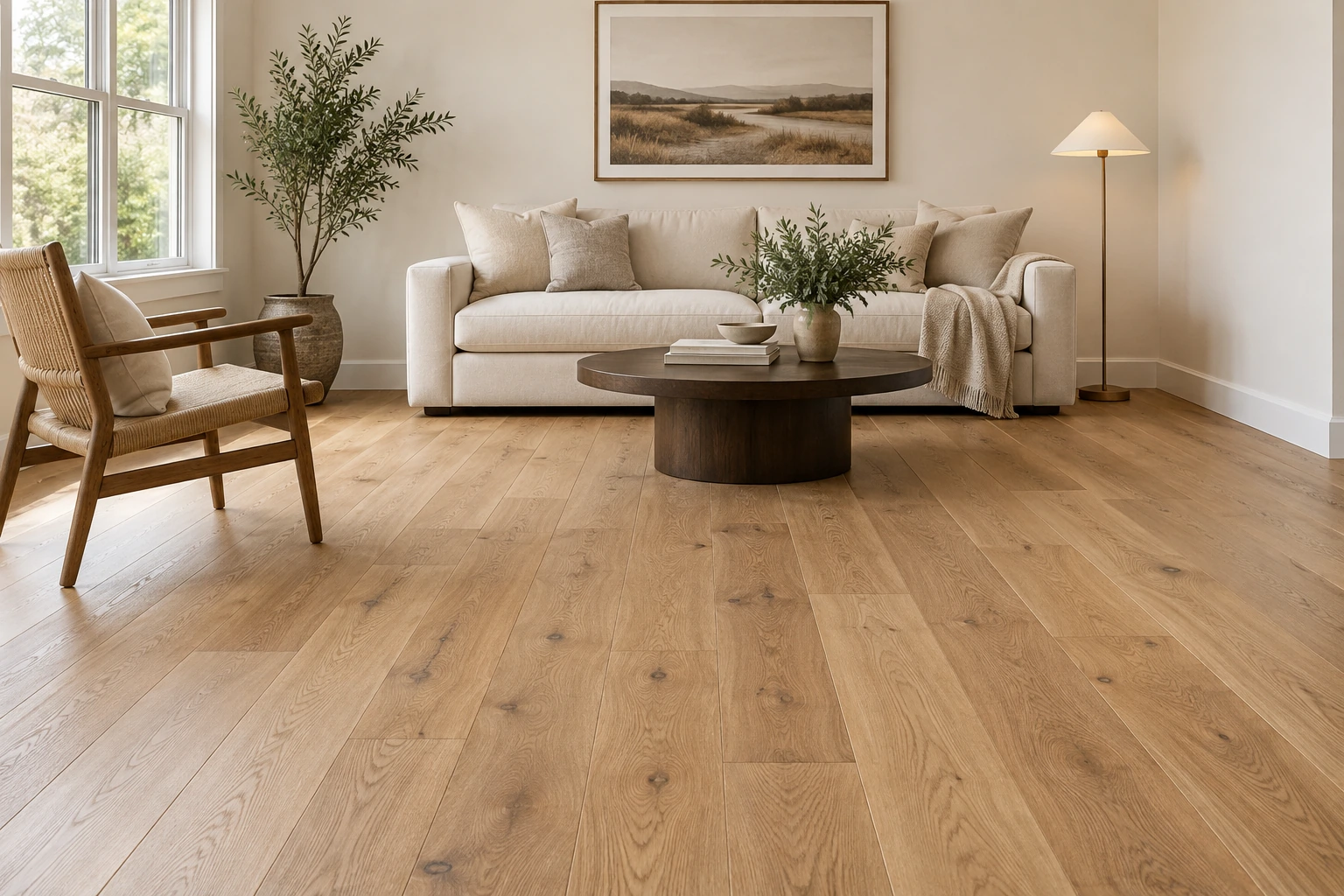
Is solid hardwood right for your room?
Solid hardwood is milled from a single piece of wood, usually around 3/4 inch thick. Because the whole board is wood, it can be sanded and refinished several times over its life, which is why many original floors in older Portland homes are still in use a century later. If you already have hardwood that looks worn, ask about hardwood floor refinishing before replacing it.
It is best suited to above-grade rooms with a wood subfloor: living and dining rooms, bedrooms, hallways and many kitchens. It is generally not recommended for below-grade basements or directly over concrete, and it is a poor fit for bathrooms or laundry rooms where water is likely. In those areas we usually suggest engineered wood, LVP or tile.
Choosing species, width and finish
Species
Red oak and white oak are the most common choices and are widely available. Maple is harder and has a tighter, quieter grain. Hickory is very hard with dramatic color variation. Harder species resist dents better but can be more expensive and harder to sand.
Board width
Narrow strip flooring (around 2 1/4 inches) is classic in older homes; wider plank is popular in newer interiors. Wider boards show seasonal movement more, so product choice and moisture control matter more as width increases.
Prefinished or site-finished
Prefinished boards arrive with a factory finish and can usually be walked on soon after installation. Site-finished floors are sanded and coated in place, which allows custom stain colors and a flush surface but adds drying time. Tell us which you are considering so the scope matches.
Moisture, acclimation and Portland's seasons
Wood expands when the air is humid and shrinks when it is dry. In the Portland area, damp winters outdoors and heated, drier air indoors mean small seasonal gaps between boards are normal. Problems such as cupping usually trace back to moisture from below, often a crawlspace without an effective vapor barrier.
Before installation, hardwood should acclimate according to the manufacturer's instructions, and the subfloor's moisture should be within the range the manufacturer specifies. We check moisture levels and let you know if a crawlspace or subfloor issue should be addressed first.
How hardwood installation works
- Review rooms, doorways, stairs and transitions, and confirm the product and quantity (including waste allowance)
- Remove existing flooring if needed (flooring removal) and inspect the subfloor
- Fix squeaks, loose panels and flatness problems (subfloor preparation and leveling)
- Install underlayment as specified, then nail down the boards with proper expansion space
- Fit baseboards and transitions, clean up and walk the finished floor with you
Stairs, custom borders and site finishing add time and cost. Use the Price Guide for a material budget and our installation cost guide for the other parts of the project.
Material price ranges
| Material | Good · Entry | Better · Mid-range | Best · Premium |
|---|---|---|---|
| Solid hardwood | $6–$8 | $8–$11 | $11–$15 |
Material-only planning ranges per square foot from the Banana Floors Price Guide. Installation, removal, floor preparation, underlayment, trim, transitions, delivery and taxes are not included.
Hardwood installation questions
Can hardwood be installed over concrete or in a basement?
Solid hardwood is generally not recommended below grade or directly over concrete because of moisture. Engineered wood, LVP or tile are usually better choices there. Check the manufacturer's requirements for your exact product.
How long should hardwood acclimate before installation?
Follow the manufacturer's instructions for your product. Acclimation time depends on the product, the home's conditions and the measured moisture of the wood and subfloor, so there is no single number for every job.
What affects the cost of hardwood installation?
Removal of the old floor, subfloor repairs, the number of rooms and transitions, stairs, board width, and whether the floor is prefinished or site-finished. Send measurements and photos and we will review the scope with your material budget.
Should I choose solid or engineered hardwood?
Solid hardwood can be refinished more times and works well above grade on wood subfloors. Engineered wood is more dimensionally stable and can often go over concrete or below grade. See our engineered wood page for a comparison.
Do you refinish existing hardwood floors?
Yes. We refinish existing hardwood floors (sanding and refinishing, or a screen and recoat) as well as installing new hardwood. See our hardwood floor refinishing page.